Training Tip: Horse Pins His Ears When You Walk Past His Stall
A horse pins his ears and acts defensive when you walk past his stall because he is protective of his area. It’s an all-too common problem at boarding stables. The fix is making your horse realize that you can control his feet anywhere, whether it’s in the roundpen, the arena, the pasture, on the trail or in the stall.
As a general rule, horses at boarding stables get away with bad behavior because no one is willing to correct a horse that doesn’t belong to them and it doesn’t take long at all for bad habits to form. Personally, if my horse were acting out, I’d want people to correct him. Horses in boarding stables are really a lot like other people’s kids misbehaving in public. How many parents are comfortable with a stranger correcting their children? Not many. Now, if it were me, and my kid was acting up, I’d hope someone would straighten him out. But no one is game to interact someone else’s kid for fear of getting sued. When I was a kid in Australia and my friends and I were messing around or doing something stupid and someone caught us doing it, they’d come over and straighten us out. Then they’d drag us home and tell our parents what we did. Our parents would thank them for pulling us back into line, and then they’d straighten us out again. Could you imagine doing that to someone’s kid now in America?
From time to time, any horse who is kept in a stall may pin his ears or give you a dirty look. If you’ve done your homework and taught your horse the Fundamentals exercises, one quick fix, putting his feet to work, will nip the problem in the bud. If you haven’t done the Fundamentals exercises with your horse, mainly the groundwork exercises, you need to. Otherwise, trying to fix the horse pinning his ears at you is like putting a Band-Aid on a sore. You’re just covering up the real problem. Your horse is pinning his ears at you because you haven’t earned his respect and trust. The Fundamentals exercises will help you do just that.
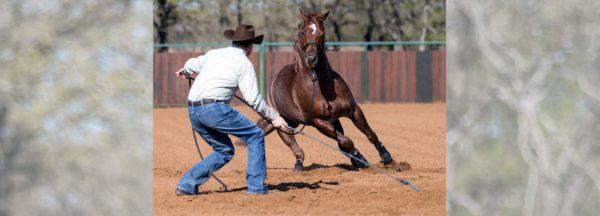
If a horse has a longstanding habit of pinning his ears and getting snarly as people pass by the stall, you can keep the halter and lead rope on him. That way, when he pins his ears, you can quickly enter the stall, grab the lead rope and hustle his feet. You can back him around the stall or lunge him in a small circle. Remember, horses are basically lazy creatures and the worst punishment you can give them is to move their feet.
However, if your horse is extremely dominant and disrespectful, you do not want to enter the stall with him to correct this behavior. He’s likely to strike out at you when you get after him, and there’s a good chance he’ll kick you since there is not a lot of room to work with in a stall. Again, the answer is to do the Fundamentals, starting with the roundpenning exercises. If your horse is so belligerent that one roundpen session doesn’t straighten him out, let him live in the roundpen for a few days so that you can safely work with him. You can put hay and water in the pen when you’re not working with him.
You have to remember that horses are big, powerful animals and we’re fragile compared to them. When something goes wrong, we come out on the wrong end of the deal. Your safety is your number one priority when working with your horse.
Have a horsemanship question or looking for more training tips? Check out the No Worries Club.
