Training Tip: Successfully Introduce an Obstacle to Your Horse
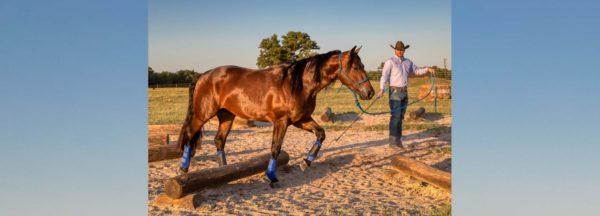
When you introduce your horse to an obstacle—a log on the ground, a puddle of water, a gulley, the trailer, etc.—the first step is to build the horse’s confidence around the object by sending him between you and it on all four sides of the object. It’s a little test: If you can’t get your horse to go between you and the object, you’re never going to get him to go over it or through it. I primarily use the Sending Exercise to familiarize my horses with a new obstacle. Sending requires keeping your feet still while the horse walks or trots in an arc between you and the object. At the end of each half circle, he yields his hindquarters and turns to face you with two eyes before you send him back the other way.
When you can send the horse between you and the object on all four sides of it and he’s passing by you in a relaxed, confident manner, then it’s time to use the Approach and Retreat Method to get him to go over or in the obstacle. The Approach and Retreat Method is like a cat-and-mouse game that allows you to build your horse’s confidence in any situation without forcing him to do anything. Using Approach and Retreat, you’ll make going over the obstacle the horse’s idea. Start by sending the horse up to the log or the object you’re using. At first, he may stop and try to back away from it, which most horses will do because they’re nervous and unsure of the situation.
If you think the horse is going to stop in nine steps, stop him in eight steps. Then back him away from the log. You’re going to send the horse forwards and backwards. Ask him to go forward, and before he stops by himself, stop him and back him away. Then send him forward again and try to get him to come a little closer to the obstacle.
The trick is to stop him before he wants to stop. That way, stopping is always your idea. The more you retreat, the more you act like you don’t want him to go near the obstacle and the more curious the horse becomes. The more you tell a horse not to do something, the more he’ll want to do it. So the more you keep stopping the horse from going across the obstacle, the more it increases his curiosity.
If he stops and starts backing away before you ask, use the Handy Stick and string to apply pressure toward his hindquarters. As soon as he tries to come forward, even a little bit, immediately reward him by taking the pressure away. Then back him away a few steps and try again. Anytime the horse wants to smell or investigate the obstacle, let him. Horses sometimes need to perform their own little safety check on an object before they’re comfortable with it. He might lick it, paw it, chew on it, etc. Depending on how fearful the horse is of the object, it may take you a couple of days using Approach and Retreat before he is comfortable with the obstacle.
If you continue at this “game,” the horse will eventually step over the obstacle. Initially, he may fumble over it or jump it in a hurry. That’s normal and should be expected. It’ll just take practice being sent over the obstacle for the horse to relax and figure out how to place his feet and negotiate it. Let him work that out himself—don’t try to slow him down or micromanage his feet.
Once the horse is going over the log, lunge him in a circle over it at a walk or trot so that you continue to work on the same side of his brain. Once he’s comfortable going over the obstacle in one direction, where he steps over it calmly, then you can switch directions so that you’re working on the other side of his brain. Horses have two brains: Righty and Lefty. Each side thinks and reacts separately. Just because your horse is confident about stepping over the log going to the right doesn’t mean he’ll be calm about it going to the left. In fact, he’ll probably act like he’s never seen the log before and you’ll have to start back at the beginning steps with him to build his confidence.
Once the horse is stepping over the log, don’t quit. Send him over it several times until he’s going over it in a relaxed, confident manner. Soon, picking up his feet and negotiating the log won’t be any big deal to him. He will learn to take it in stride.
Have a horsemanship question or looking for more training tips? Check out the No Worries Club.
